
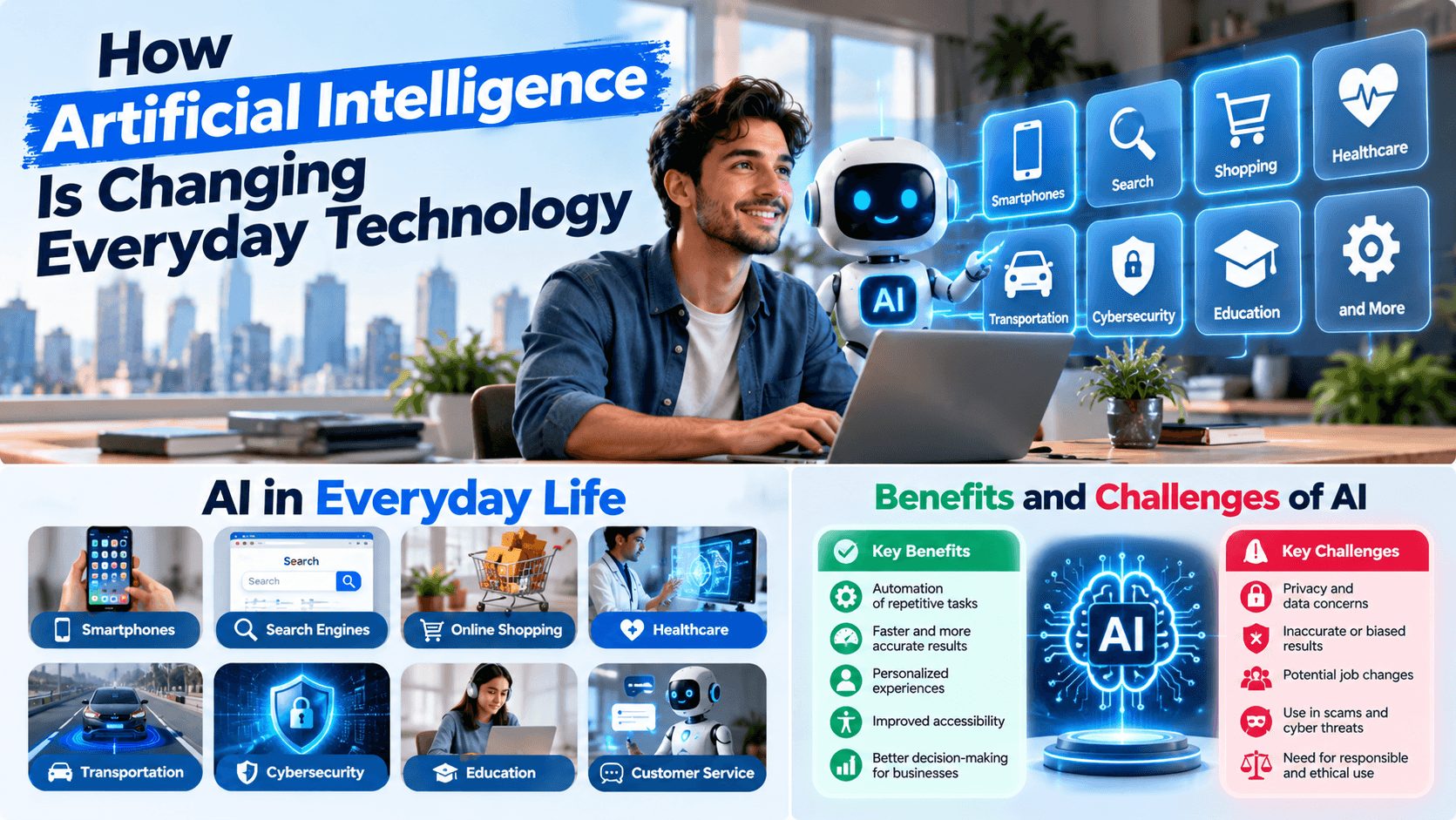
Artificial intelligence is becoming a major part of modern technology. It is no longer limited to research labs or large technology companies. Today, AI is built into smartphones, search engines, cars, online stores, healthcare systems, security tools, and many everyday apps.
As AI continues to improve, it is changing how people work, communicate, shop, travel, and access information. Understanding these changes can help users make better decisions about the technology they use every day.
What Is Artificial Intelligence?
Artificial intelligence refers to computer systems that can perform tasks that normally require human intelligence. These tasks may include recognizing images, understanding language, analyzing information, making predictions, and generating content.
AI systems usually learn from large amounts of data. They identify patterns and use those patterns to produce results, recommendations, or automated actions.
For example, a streaming platform may use AI to recommend movies based on viewing history. A smartphone camera may use AI to improve image quality automatically.
How AI Is Used in Everyday Technology
AI is already present in many common devices and services. Some people use artificial intelligence every day without realizing it.
Common Uses of Artificial Intelligence
Technology Area | How AI Is Used | Everyday Example | Main Benefit |
|---|---|---|---|
Smartphones | Voice recognition, photography, battery optimization | Voice assistants and smart cameras | Easier device use |
Search Engines | Understanding search intent and ranking results | More relevant search results | Faster access to information |
Online Shopping | Product recommendations and personalized offers | Suggested products | Better shopping experience |
Healthcare | Data analysis and medical support tools | Detecting patterns in scans | Faster decision support |
Transportation | Navigation and driver-assistance systems | Traffic prediction | Safer and faster travel |
Cybersecurity | Detecting unusual activity | Fraud and malware detection | Improved online security |
Education | Personalized learning and automated assistance | AI tutoring tools | More flexible learning |
Customer Service | Automated chat and support systems | AI chatbots | Faster responses |
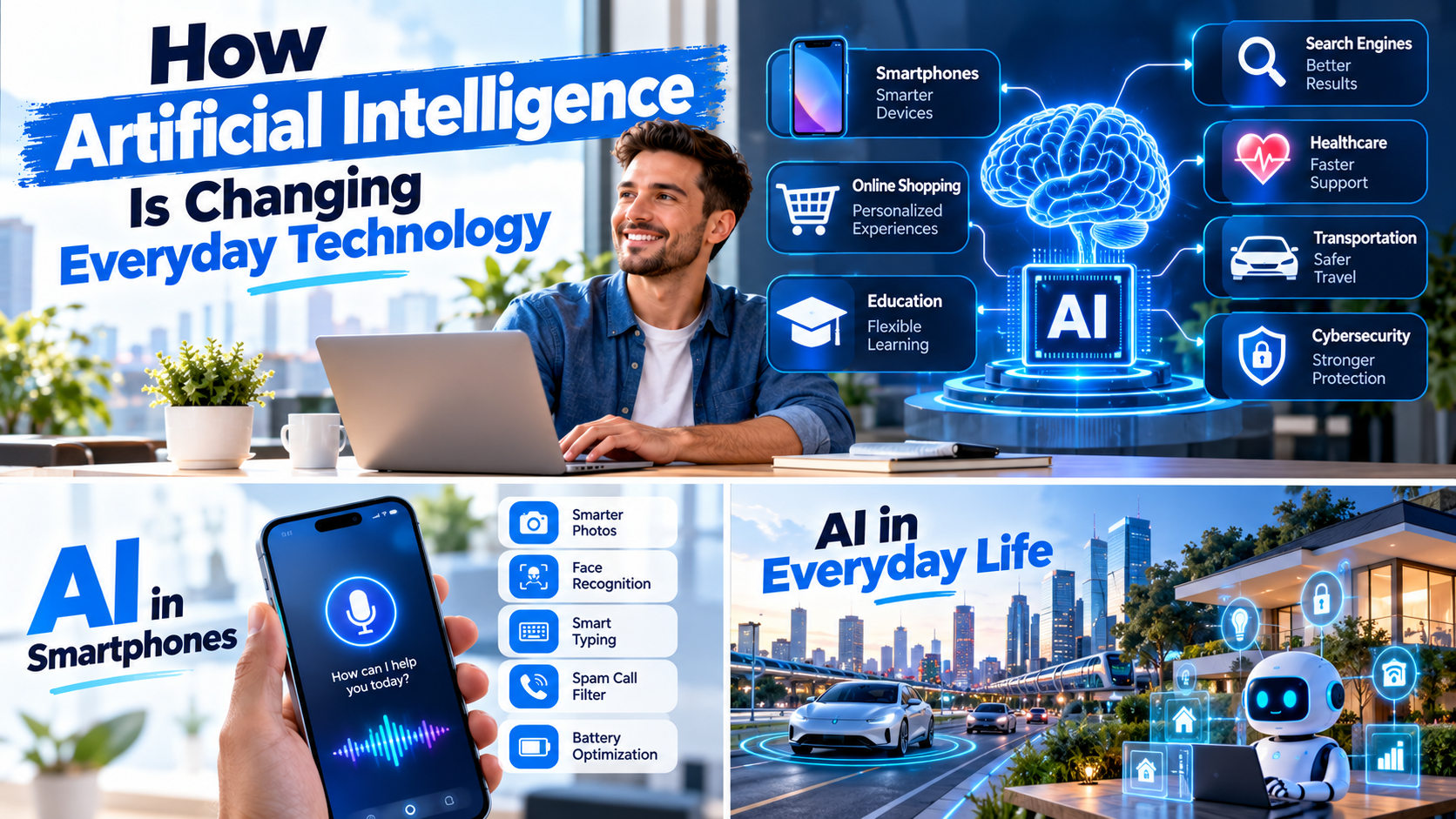
AI in Smartphones
Smartphones are one of the clearest examples of how AI has become part of daily life.
Modern phones use artificial intelligence to improve photos, recognize faces, organize images, suggest words while typing, filter spam calls, and manage battery usage.
Smarter Mobile Photography
Phone cameras use AI to identify different scenes, adjust brightness, reduce noise, and improve colors. Portrait modes can separate people from backgrounds, while night modes combine multiple images to produce clearer photographs in low light.
These improvements allow everyday users to take better photos without manually adjusting complicated camera settings.
AI and Online Search
Search technology has become more advanced because of artificial intelligence.
Instead of simply matching keywords, modern search systems can often understand the meaning behind a question. This helps users find more relevant information.
AI can also support voice search, image search, translations, and personalized recommendations.
However, users should still evaluate information carefully because AI-generated or AI-ranked results can sometimes contain mistakes.
Artificial Intelligence in Online Shopping
Online retailers use AI to understand customer behavior and recommend products.
For example, a shopping website may analyze products someone viewed, searched for, or purchased. It can then suggest similar items.
Personalized Shopping Experiences
AI can also help businesses predict demand, manage inventory, detect payment fraud, and provide customer support.
Although personalization can make shopping more convenient, users should pay attention to privacy settings and understand how companies may collect and use their data.
AI in Healthcare
Artificial intelligence is also becoming increasingly useful in healthcare.
AI systems can analyze large amounts of medical information and help healthcare professionals identify patterns that may be difficult to notice manually.
For example, AI-assisted tools may support the analysis of medical scans, patient records, and laboratory results.
Supporting Healthcare Professionals
AI is generally used as a support tool rather than a replacement for trained medical professionals. Human judgment remains important, especially when making diagnoses or treatment decisions.
As healthcare technology develops, responsible use of AI will require strong privacy protections and careful testing.
AI in Transportation
Artificial intelligence is changing transportation through smarter navigation, traffic management, and driver-assistance technologies.
Navigation apps can analyze traffic conditions and recommend faster routes. Some modern vehicles also include features such as automatic emergency braking, lane assistance, and parking support.
Smarter Traffic Systems
Cities can use AI-based traffic systems to analyze traffic flow and adjust signals. These systems may help reduce congestion and improve transportation efficiency.
Fully autonomous vehicles are also being developed, although their availability and capabilities vary by location and regulation.
AI and Cybersecurity
Cybersecurity is another important area where artificial intelligence is widely used.
AI-powered security systems can examine large amounts of network activity and detect unusual behavior.
Detecting Threats Faster
Banks and financial services may use AI to identify suspicious transactions. Email providers can use automated systems to detect spam and phishing messages.
However, cybercriminals can also use AI to create more convincing scams. This means users should continue following basic security practices such as using strong passwords and enabling multi-factor authentication.
AI in Education
Artificial intelligence is creating new opportunities for students and teachers.
AI-powered educational tools can explain concepts, generate practice questions, provide feedback, and adapt lessons based on a learner's progress.
Personalized Learning
Students may be able to learn at their own pace using systems that identify areas where they need additional practice.
Teachers can also use technology to organize learning materials and reduce repetitive administrative work.
Still, AI should support learning rather than replace critical thinking, independent research, or communication with teachers.
Benefits of Artificial Intelligence
Artificial intelligence offers several important benefits.
It can automate repetitive tasks, process information quickly, improve accessibility, provide personalized experiences, and help organizations make better decisions.
AI can also help people save time by handling tasks that previously required more manual effort.
For businesses, automation may improve productivity and allow employees to focus on more complex work.
Challenges and Risks of AI
Despite its advantages, artificial intelligence also creates challenges.
One major concern is privacy. AI systems often require large amounts of data, which makes responsible data collection and storage important.
Accuracy and Bias
AI systems are not always correct. They may produce inaccurate answers or reflect biases found in their training data.
People should avoid assuming that an AI-generated response is automatically reliable.
Job Changes
Automation may also change certain jobs. Some repetitive tasks could become automated, while new jobs may appear in technology, data analysis, AI management, and cybersecurity.
The impact will likely vary between industries.
How to Use AI Responsibly
People can benefit from artificial intelligence while still using it carefully.
Before relying on important AI-generated information, verify it using reliable sources. Avoid entering sensitive personal information into unfamiliar AI services.
Users should also review privacy settings and understand what information an app or platform collects.
For important decisions involving health, finance, law, or safety, professional guidance should not be replaced by automated tools.
The Future of Artificial Intelligence
Artificial intelligence is likely to become even more integrated into everyday technology.
Future systems may offer more advanced personal assistants, smarter transportation, improved healthcare tools, and more efficient workplaces.
At the same time, governments, companies, and users will need to address questions about privacy, transparency, security, and responsible AI development.
Conclusion
Artificial intelligence is changing how people interact with technology every day. From smartphones and online shopping to healthcare, transportation, education, and cybersecurity, AI is helping systems become faster, smarter, and more personalized.
However, artificial intelligence also brings important responsibilities. Users should understand its limitations, protect their personal information, and verify important information before making decisions.
As AI continues to develop, learning how to use it responsibly will become an increasingly important digital skill.